Swimming in cenotes from Cancún: the three types, the rules and the clock
A cenote is a collapsed cave with groundwater in it. The type decides the light, the temperature, the depth and whether you wear a life jacket. A field guide for anyone starting from Cancún, Tulum or Mérida.
In this article
- What is a cenote, exactly?
- Where are the cenotes near Cancún, Mérida, Valladolid and Tulum?
- Is there a time difference between Tulum and Valladolid, and when do cenotes open?
- Open, semi-open or cave: which cenote should you pick?
- What should you bring to a cenote?
- What are the rules in a cenote: sunscreen, shower and life jacket?
- What do people ask before swimming in a cenote?
One table, many windows
All the cenotes around Mérida, Valladolid and Tulum are windows onto one groundwater table under Yucatán. How much roof is left decides the type: open like Xbatún, semi-open like Ik Kil and Gran Cenote, or cave like Suytun. The water stays at 24 to 25 degrees Celsius (75 to 77 Fahrenheit) all year.
Can you wear sunscreen in a cenote? No. The biologists of the Cenoteando project at Mexico's National Autonomous University (UNAM) put it at the top of their 2024 poster of good practices for cenotes: rinse off before you go in, and do not apply sunscreen, insect repellent, cream or deodorant, because they damage the quality of the water. The water you swim in is the drinking water of a whole peninsula.
That strictness follows from what a cenote is. Once you see that, you do not need a ranked list: the type tells you what you will find down there, and what it asks of you.
What is a cenote, exactly?
A cenote is a place where the roof of an underground cave has collapsed, so you look straight down into the groundwater. The Yucatán peninsula is a slab of limestone with no rivers on the surface. Rain sinks straight into the ground, dissolves the limestone on the way and flows to the sea through passages under your feet. A 2024 study in the journal Water sums it up: the only fresh water on the peninsula is groundwater from a mature karst aquifer, one of the largest in the world.
The groundwater lies as one table under the whole land, and every cenote is a window onto it. So the water stands at the same height everywhere. What differs is how much roof is left above the window. If the roof is intact apart from a small opening, you have a cave cenote, the youngest form. If part of it has collapsed, you get a semi-open cenote with a hole in the ceiling. If the roof is gone altogether, you have an open cenote, like a small lake in the forest: the oldest form. Xcaret's overview from December 2024 sorts them the same way.
Where are the cenotes near Cancún, Mérida, Valladolid and Tulum?
Around Mérida are Xbatún and the Santa Bárbara cenotes in Homún, around Valladolid Ik Kil, X'Kekén, Suytun and Zací, and near Tulum Gran Cenote and Dos Ojos, with Jardín del Edén toward Playa del Carmen. Whichever of those three towns you sleep in, you have a group of cenotes within reach.
If you start from Cancún, you start in Quintana Roo, the same state as Tulum and Playa del Carmen. The cenotes around Tulum are on your side of the state line. Valladolid, Ik Kil and Mérida are in the state of Yucatán, and that matters twice over: the clock is one hour behind, as the next section shows.
West of Valladolid, around Mérida, the cenotes lie in an arc across the land. That is no coincidence. According to a study in Frontiers in Earth Science from May 2025, an asteroid struck here 66 million years ago, leaving a crater about 200 kilometers (124 miles) wide with its center at the coastal village of Chicxulub Puerto. Half of that crater lies under the sea. The other half is buried under the limestone, and its rim shows at the surface as a half ring of cenotes. So you swim in the groundwater on the rim of a meteorite crater. Homún, with the Santa Bárbara cenotes, lies on that arc.
Valladolid sits in the middle. Cenote Zací is in the middle of town, Suytun and X'Kekén are just outside, and Ik Kil is near Pisté, next to Chichén Itzá, on the road to Valladolid. Tulum is on the Caribbean coast, where the caves under the ground are linked; Gran Cenote, Dos Ojos and Jardín del Edén all lie just inland.
- 1Xbatún open, near Mérida
- 2Santa Bárbara, Homún on the ring, near Mérida
- 3Ik Kil semi-open, near Pisté
- 4X'Kekén semi-open, near Valladolid
- 5Suytun cave, near Valladolid
- 6Gran Cenote semi-open, near Tulum
- 7Dos Ojos cave, near Tulum
- 8Jardín del Edén open, toward Playa del Carmen
Is there a time difference between Tulum and Valladolid, and when do cenotes open?
Ik Kil and Suytun open at 9 am local time, and that is 10 am on the clock in Tulum. The state of Yucatán, with Mérida, Valladolid and the cenotes around them, runs one hour behind Quintana Roo, the state of Tulum, Playa del Carmen and Cancún. Cenotes Suytun warns about it on its own site. Leave Cancún or Tulum to be at Suytun at 9 am on your own clock, and you are standing an hour early at a closed door.
At Suytun that counts double, because everything there turns on the hour. The cenote is open from 9 am to 5 pm, with last entry at 4 pm. According to the Cestee travel guide, updated in September 2026, it is quietest from 9 to 10 am, the beam of light hits the platform between 11 am and 1 pm, and after 3 pm the cave goes dark. On the clock of your hotel in Tulum, that light is there from noon to 2 pm.
Open, semi-open or cave: which cenote should you pick?
If you travel with kids or doubt your swimming, pick an open cenote. If you want the beam of light, go to a semi-open cenote around noon. If you want silence and clear water for snorkeling, a cave cenote is the choice.
| Cenote | Type | Near | Depth | Life jacket required | Open |
|---|---|---|---|---|---|
| Xbatún | open | Mérida (San Antonio Mulix) | about 4 m, shallow parts of 1 m | no source | 9 am to 5 pm |
| Santa Bárbara, Homún | three cenotes on the crater rim | Mérida | no source | included in the package | no source |
| Ik Kil | semi-open | Pisté, next to Chichén Itzá | about 48 m | yes, with lifeguards | 9 am to 5 pm |
| X'Kekén | semi-open | Valladolid (Dzitnup) | no source | no source | no source |
| Suytun | cave | Valladolid | up to about 5 m | yes | 9 am to 5 pm, last entry 4 pm |
| Gran Cenote | semi-open | Tulum | shallow along the edge, a few meters further in | yes, no entry without one | 8 am to 4:45 pm |
| Dos Ojos | cave | Tulum | about 8 to 10 m | yes, included with entry | 8 am to 5 pm |
| Jardín del Edén | open | Playa del Carmen | no source | no source | 9 am to 5 pm, not on Saturday |
Open cenotes: sun, space and an edge to stand on
An open cenote is a round lake with steep or gently sloping edges, often with trees and mangrove around it. Light falls on the water all day, so it is warmer and brighter than in a cave. You see where you are jumping in, and where you climb out. The edge is often shallow, so with kids you keep an overview.
South of Mérida is Xbatún, which Xcaret names as an example of an open cenote. On the coast near Playa del Carmen is Jardín del Edén, also open: a big pit among the rocks where you see how clear the groundwater is. Further south, near Bacalar, Xcaret counts Cenote Azul among the open cenotes too. Go in the morning rather than midday, and look for shade between swims: sunscreen is not allowed in the water.
Semi-open: one hole in the roof and a column of light
A semi-open cenote is the picture you know: a dark dome, a round hole in the ceiling, and below it a column of light on the water. It is cooler than an open cenote and the air is humid. The water is usually deep: you swim above a shaft, not in a pond.
The best-known example is Ik Kil, near Pisté next to Chichén Itzá. According to the data Wikipedia keeps on Ik Kil, the water lies about 26 meters (85 feet) below ground level, the shaft is about 60 meters (197 feet) wide and the water about 48 meters (157 feet) deep. A cut staircase takes you down to a swimming platform. The sources disagree on the type: Wikipedia calls Ik Kil open to the sky, Xcaret counts it among the semi-open cenotes. The roof is gone, but the walls are so steep and high that it feels like a well with a hole above it.
The Cenote Ik Kil site says it plainly: a life jacket is required and lifeguards are on duty. The jacket and a locker are included with entry, and the cenote is open from 9 am to 5 pm. Near Valladolid are X'Kekén and Zací, which Xcaret both counts as semi-open; Zací is in the middle of town and one of the largest. At Tulum, Gran Cenote is the semi-open cenote where most people start.
Cave cenotes: half light, silence and stairs down
In a cave cenote the roof is still intact apart from a small opening, and you get in by stairs, a tunnel or a hole in the rock. Down below it is dim. Sometimes a narrow ray of light falls through an opening, sometimes you only see the light of lamps on the water. The air is cool and damp, the rock drips and sound carries far. Walk into a cave cenote for the first time and you start to talk more quietly without noticing.
Suytun, just outside Valladolid, is the best known. A stone path leads to a round platform in the middle of the water, and around noon a beam of light lands exactly on that platform. The water is up to about 5 meters (16 feet) deep, and in some places you can stand on the bottom. Suytun itself says that the water level varies, so the platform is sometimes under water, and that no more than 150 people are let in at a time.
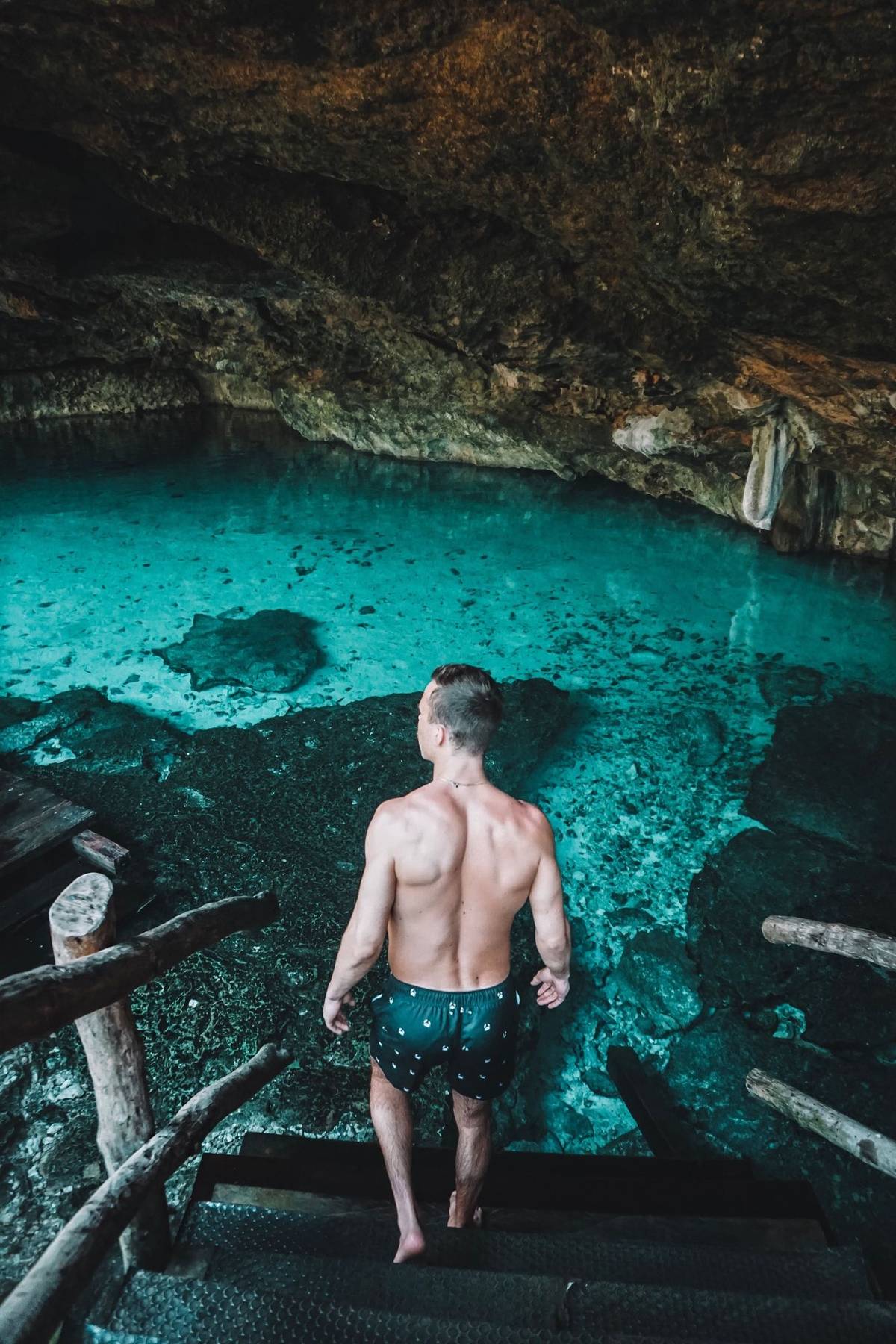
Near Tulum are the cave cenotes that divers know. According to Xcaret, Dos Ojos is part of a cave system of more than 80 kilometers (50 miles), connected to other cenotes. Calavera, also near Tulum, is another cave cenote in Xcaret's list. For swimmers and snorkelers the water here is clear; the deeper passages are for divers with a guide.
What should you bring to a cenote?
Bring cash in pesos. Not every cenote has a card machine, wrote the Mexican newspaper Por Esto in March 2026 in an article on the cenotes of Quintana Roo, and a life jacket or locker sometimes costs extra. That covers entry, renting a life jacket or a snorkel, and sometimes the ride from the parking lot to the cenote. At Santa Bárbara in Homún, a life jacket and the transport to the cenotes, by bike or in a van, already come with the package.
Bring a towel and sandals. Those are the two things Ik Kil itself lists next to swimwear, and they are what you miss when you forget them: the paths are limestone and the stairs are wet. If you want to snorkel in a clear cave like Dos Ojos, bring your own mask. Leave sunscreen at the hotel; for an open cenote bring a hat and a light long-sleeved shirt instead, and put sunscreen on only once you are done swimming.
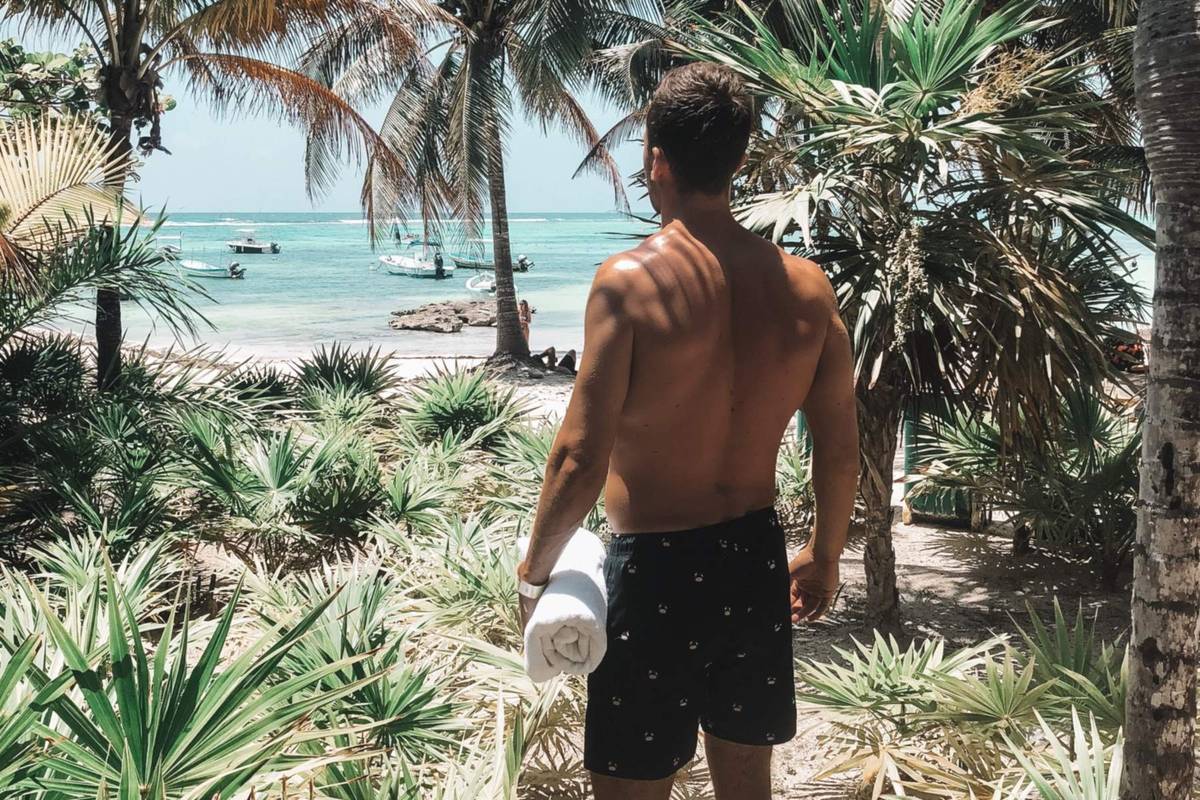
Then your swim shorts. On a cenote day you get in the water three times and back in the car twice, and in between you sit on a bench, a staircase or a bike saddle. Quick-drying fabric makes a real difference: polyester dries, cotton holds on to the water. The Venice Crabs by Sanwin Beachwear is made of peach polyester that dries fast, with an elastic waistband and drawcord, an inner brief, two side pockets and an inner pocket for coins: just the place for the coins for the locker or the pesos for a coconut. The Venice runs small and comes in letter sizes, so if you are between two, take the larger.
The Venice Ice in the photo at the top has the same build, in light pink with ice creams; all the prints of the model are in the Venice swim shorts. If your son comes along, the Crabs also exists as a boys' version. Order at home before you fly: order before 2 pm on a working day and it ships the same day from the Netherlands, with 6 to 14 working days to the United States and Canada. The shipping page has the details for your country.
What are the rules in a cenote: sunscreen, shower and life jacket?
At every cenote the rule is: no sunscreen or cream, shower first, and a life jacket where the cenote requires it, as at Ik Kil, Suytun, Gran Cenote and Dos Ojos. In the state of Yucatán those rules sit in the environmental law for cenotes, caves and cave systems, which the UNAM poster is based on; for the cenotes of Quintana Roo, around Tulum, Por Esto in 2026 names the ban on ordinary sunscreen and the life jacket requirement.
No sunscreen
No sunscreen, no insect repellent, no cream and no deodorant. The UNAM is clear about it in 2024: those products harm the quality of the water. Some guides, such as Por Esto in March 2026, recommend sunscreen that is fully biodegradable and applied well in advance. We go with the UNAM: even a product that breaks down ends up in the drinking water first, and in a cave that water hardly moves. If you arrive already covered in sunscreen, only the shower helps.
Shower before you get in
At Suytun the shower at the entrance is compulsory, according to their environmental policy. The UNAM asks the same: rinse off, so the traces of whatever is on your skin stay out of the water. Use the toilet first as well, because afterwards there is no way back up without starting over.
Life jacket where it is required
At Ik Kil a life jacket is required, with lifeguards on watch; at Suytun, Gran Cenote and Dos Ojos too, and at Santa Bárbara it comes with the package. Por Esto writes that it is required in many cenotes even if you can swim, especially the deep and the semi-open ones. The water is deep and cooler than it looks, and if you get a cramp in a 48-meter shaft the edge is no help. So put the jacket on, even if you swim well. For the rest, on most sites: no food at the water, no fire, no pets, and do not touch the stalactites. Natural swimming spots elsewhere have rules of their own too; our guide to the Bali waterfalls goes through them.
What do people ask before swimming in a cenote?
The water in a cenote is 24 to 25 degrees Celsius all year, kids can come along with a life jacket, and anyone who swims poorly wears that jacket always. It is quietest at opening, at 9 am local time.
How cold is the water in a cenote?
The water is about 24 to 25 degrees Celsius (75 to 77 Fahrenheit) all year, reports Programa Destinos México. That is a touch cooler than the Caribbean, which our piece on sea temperature in December puts at 27 degrees off Aruba and Curaçao. In a cave cenote it feels colder, because the air is cool and you do not dry off in the sun. Visibility under water is best in the dry season, from November to April.
Can you go to a cenote with kids?
Yes. Pick an open cenote with a shallow edge or a cave where you can stand, like Suytun, and always have kids wear a life jacket. At Ik Kil, kids under 1.20 meters (3 feet 11 inches) enter free and a child rate applies up to 1.40 meters (4 feet 7 inches). A steep staircase of dozens of steps is a climb for small kids, so check beforehand how you get down.
What if you are not a good swimmer?
A cenote is still doable. Wear the life jacket, even where it is not required. Pick a place with a lifeguard, like Ik Kil, or a cenote where you can stand on the bottom. Stay by the stairs or the platform, and go in the morning, when it is quiet in the water.
When is a cenote quietest?
Right at opening, usually 9 am local time. Ik Kil and Suytun both open at 9 am, and Por Esto also advised in March 2026 to arrive between 8 and 10 am, ahead of the lines. Coming from Cancún or Tulum, allow for the hour of difference: 9 am in Valladolid is 10 am in Tulum.
How fast will my swim shorts arrive?
Order before 2 pm on a working day and your order ships the same day from the Netherlands. Delivery takes 3 to 7 working days within Europe, 6 to 14 to the United States and Canada and 8 to 10 to Australia and New Zealand. Shipping within Europe is free from two pieces.
An exchange starts from returns and exchanges.
Also read
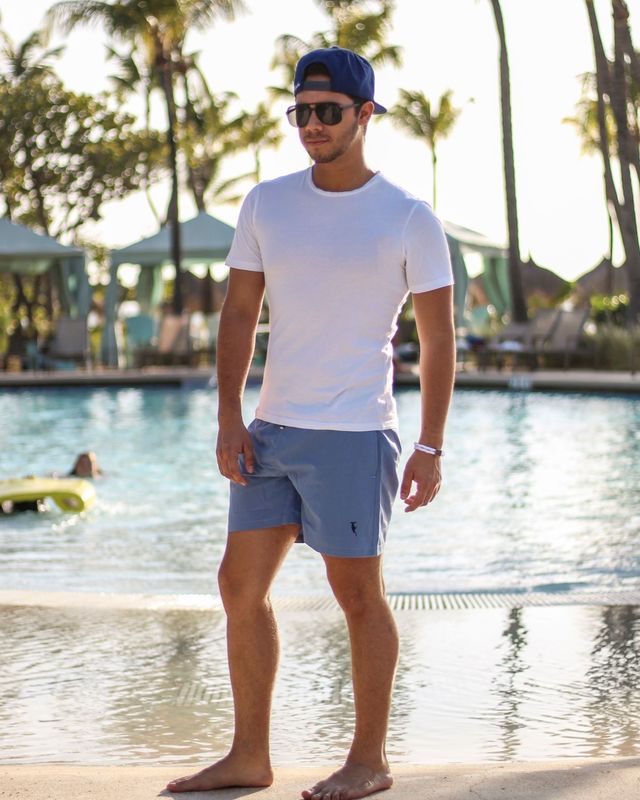
Christmas gifts for him: seven that go on the trip
For anyone shopping in December for a man who travels: seven gifts he wears on the road next year, from his head to his hips, with why each one works on a trip and which swim short size to choose.
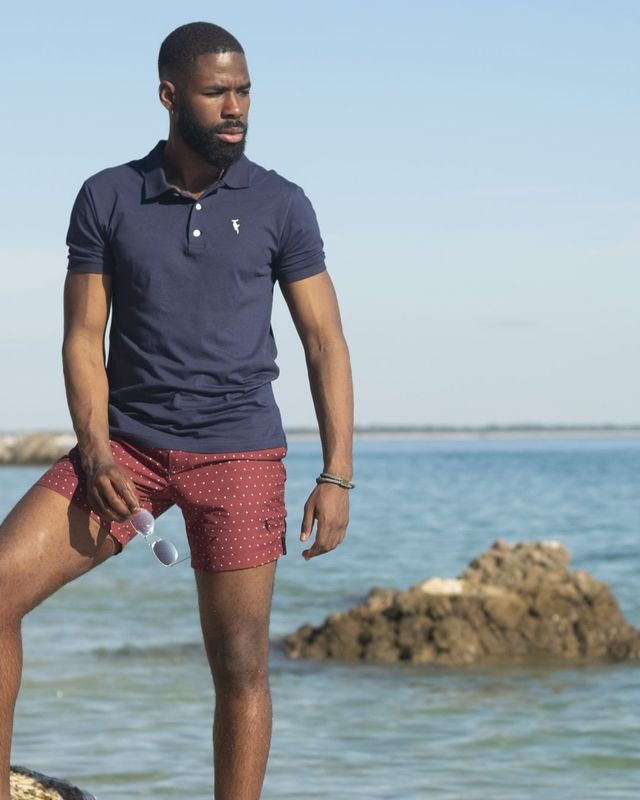
Beach vacation packing list for men: one week in carry-on
A week at the beach in the free bag under the seat: the list to tick off, the kilos and litres of British Airways, easyJet, Ryanair and Jet2, and two swim shorts that go with every shirt.
Tipping in France: what the French actually leave
Service is always in the menu price by law. What the French add on top, from the coffee on the terrace to lunch at a plage privée, moment by moment.