Eagle Beach Aruba: the wide beach with the leaning trees
Why the fofoti leans, and what the same trade wind does to the bus, the sand, the sea and the seasons on the widest beach of Aruba.
In this article
Eagle Beach Aruba is the island's widest beach, on the calm west coast just south of Palm Beach. Two of Aruba's best-known fofoti trees stand on it, bent toward the sea by a trade wind that averages 17 mph (27 km/h). Bus 10A stops right there, and the beach is public and free to enter.
You step off bus 10A at the Eagle Beach stop, cross J.E. Irausquin Boulevard and walk onto the sand. The wind is at your back all the way to the water. A little further along stands a tree that faces the same way you do. Its trunk winds low across the sand, its crown hangs over the sea, and on the side that bends toward the water a wooden post holds it up. On Aruba it is called a fofoti. To know which way the wind blows here, you only have to look at that tree.
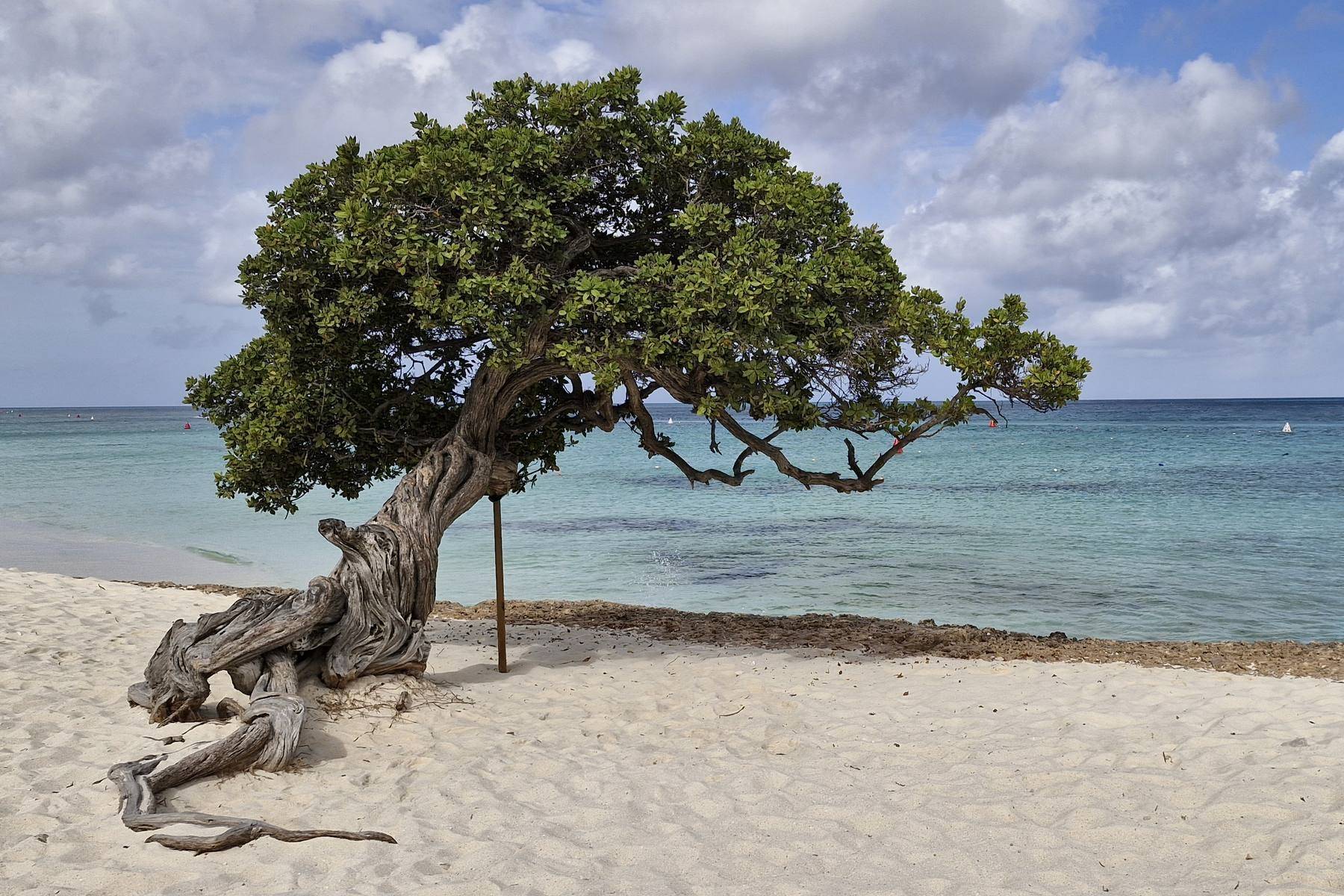
Why does the fofoti on Eagle Beach lean?
Because the trade wind has pushed it the same way all its life. On Aruba the wind comes on average from 85 degrees, just north of east, at 7.4 meters per second: about 17 mph (27 km/h), according to the climate normals 1991 to 2020 of the Meteorological Service of Aruba. Eagle Beach lies on the west coast, so that wind blows here from the land out to sea. The fofoti grows with it, and its crown points toward the Caribbean Sea, writes the Aruba Tourism Authority.
That turns one tree into a weather vane. Stand under the crown and look back along the trunk toward the boulevard, and you are looking straight into the wind; the crown points the way the sun sets. The fofoti (Conocarpus erectus) grows right at the coast and is often confused with the divi-divi, which also leans and points southwest. Eagle Beach has two fofoti trees that rank among the most photographed on Aruba. Follow the wind from the road to the water and you know the whole beach: first the bus stop, then the wide sand with the nests, then the sea in the lee.
Where do you get off for Eagle Beach, and how does it compare with Palm Beach?
At the Eagle Beach stop of bus 10A, with the wind at your back. The beach runs along J.E. Irausquin Boulevard, and across the road or close by stand Aruba's low-rise hotels, writes the Aruba Tourism Authority. Its hotel listing for the MVC Eagle Beach places it on the boulevard "across Aruba's best beach" (Aruba Tourism Authority).
Bus 10A from Arubus runs from the bus station in Oranjestad to Arashi Beach and leaves in that direction every 20 minutes, from 06:15 to 18:10. Along Eagle Beach it stops at Chalet Suisse, Amsterdam Manor and the Eagle Beach stop; from the bus station that is 3.6 km (2.2 miles) as the crow flies. With a rental car or a taxi you park in the public lot at the beach. According to the Aruba Tourism Authority you also find shade, beach huts, water sports and places to eat and drink.
Stay on until the stop at the Hilton and you are 2.5 km (1.6 miles) further, at Palm Beach: more than 3 km (about 2 miles) of beach with Aruba's high-rise hotels right on the sand, piers, beach bars and water sports. Eagle Beach is wider and has less built up behind it. If your hotel is on Palm Beach, Eagle Beach is a day out with more room around you.
| Eagle Beach | Palm Beach | |
|---|---|---|
| Beach | Aruba's widest beach | More than 3 km (about 2 miles) of beach |
| Hotels | Low-rise hotels near or across the boulevard | High-rise hotels right on the sand |
| On the beach | Public parking, shade, beach huts, water sports, places to eat and drink | Piers, beach bars, water sports |
| Bus 10A | Eagle Beach stop, 3.6 km (2.2 miles) from the Oranjestad bus station | Hilton stop, 2.5 km (1.6 miles) beyond the Eagle Beach stop |
| Turtle nests | Most on the island | Not mentioned by the tourist board |
When do turtles lay eggs on Eagle Beach?
From March through December. In those months four species come ashore on Aruba to lay eggs: the leatherback, the hawksbill, the green turtle and the loggerhead, reports the government of Aruba. Most of the island's nests are on Eagle Beach, according to the Aruba Tourism Authority: in the wide sand between the boulevard and the waterline, where you put your towel too.
The foundation Turtugaruba checks every beach every day in the season and puts a barrier around vulnerable nests. Artificial light makes turtles lose their way. On average Turtugaruba protects around 6,700 hatchlings a year. What you do when you are on Eagle Beach in those months:
- Keep your distance from a turtle that comes ashore and do not disturb her while she lays.
- Leave nests and the barrier around them alone.
- Use no light on or along the beach in the evening, not even your phone's flashlight.
- Fill in holes in the sand and take your trash with you.
- If you see a turtle making a nest, call Turtugaruba: 592 9393 (add +297 from outside Aruba).
For shade, look for the public palapas. They are first come, first served, and a hotel may not hold them for its guests. If you want one, take an early bus: the first 10A leaves Oranjestad at 06:15.
Why is the water at Eagle Beach so calm?
Because the trade wind blows off the land here. The waves and the hard wind are on the north and east coasts, where the wind comes off the sea; the west coast lies in the lee and is calm and sheltered, writes the Aruba Tourism Authority. That makes Eagle Beach a beach for swimming. The tourist board says nothing about lifeguards, flags, toilets or showers. Do not assume they are there, and bring your own water.
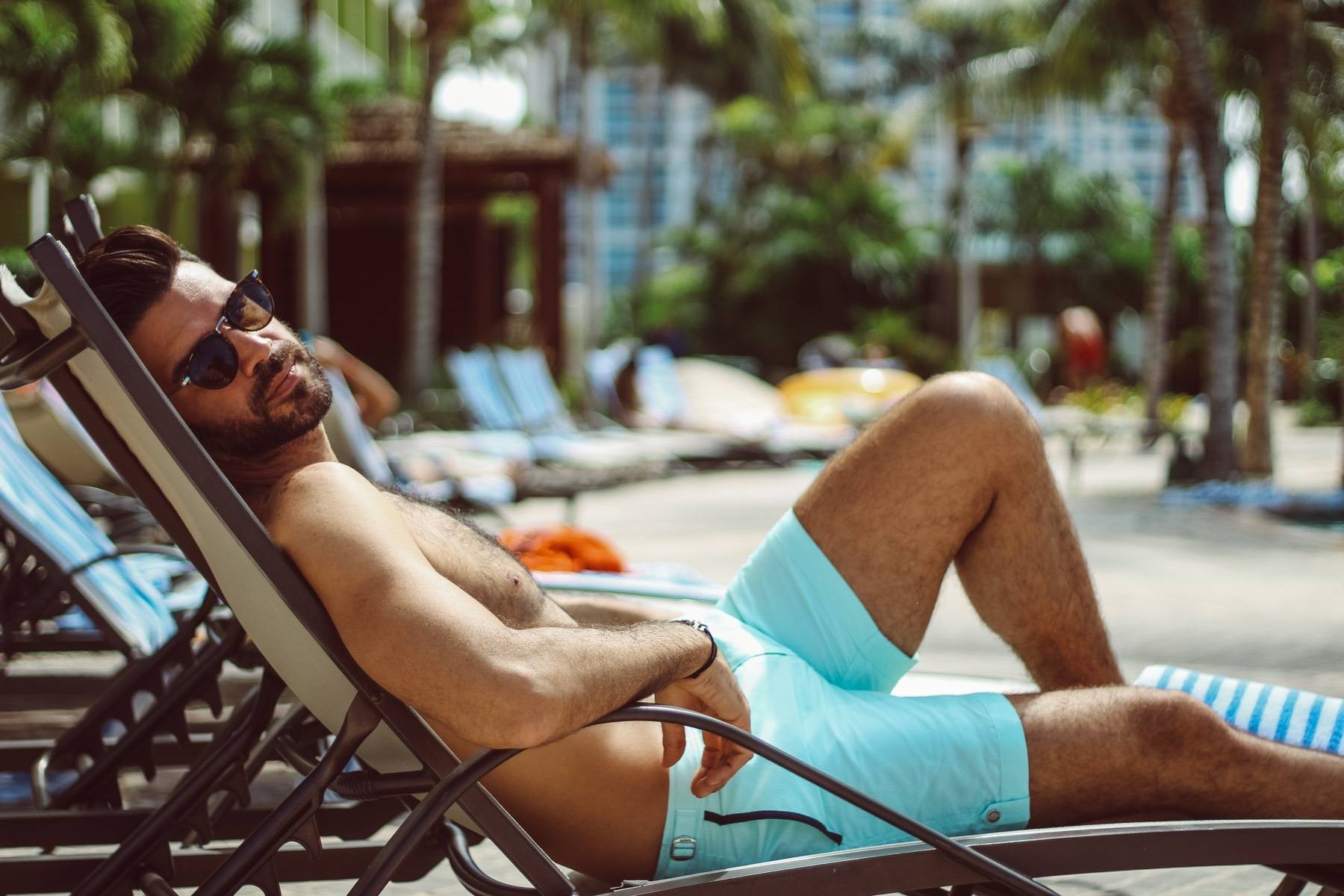
When you come out of the water, you walk back to your towel under the palapa with the wind in your face, and later over the sand to the terraces on the boulevard. On that walk your hotel key card sits in the zip back pocket of the Sanwin Tampa, and you sit down to dinner in the same short swim shorts.
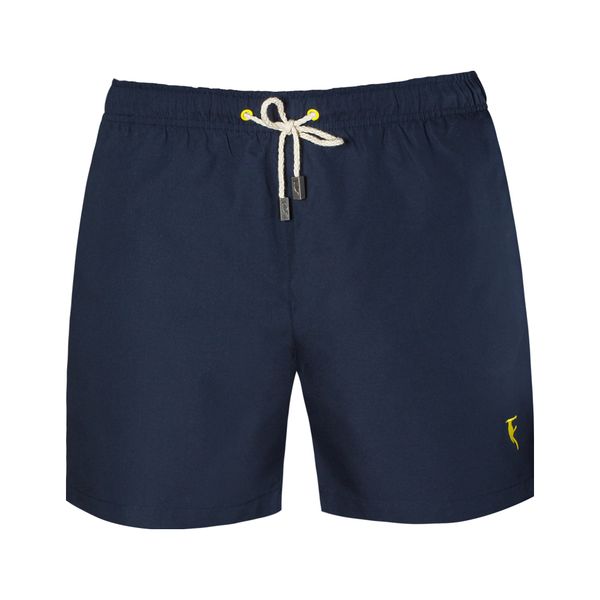 Miami Sanwin Bluedark blue, drawstring
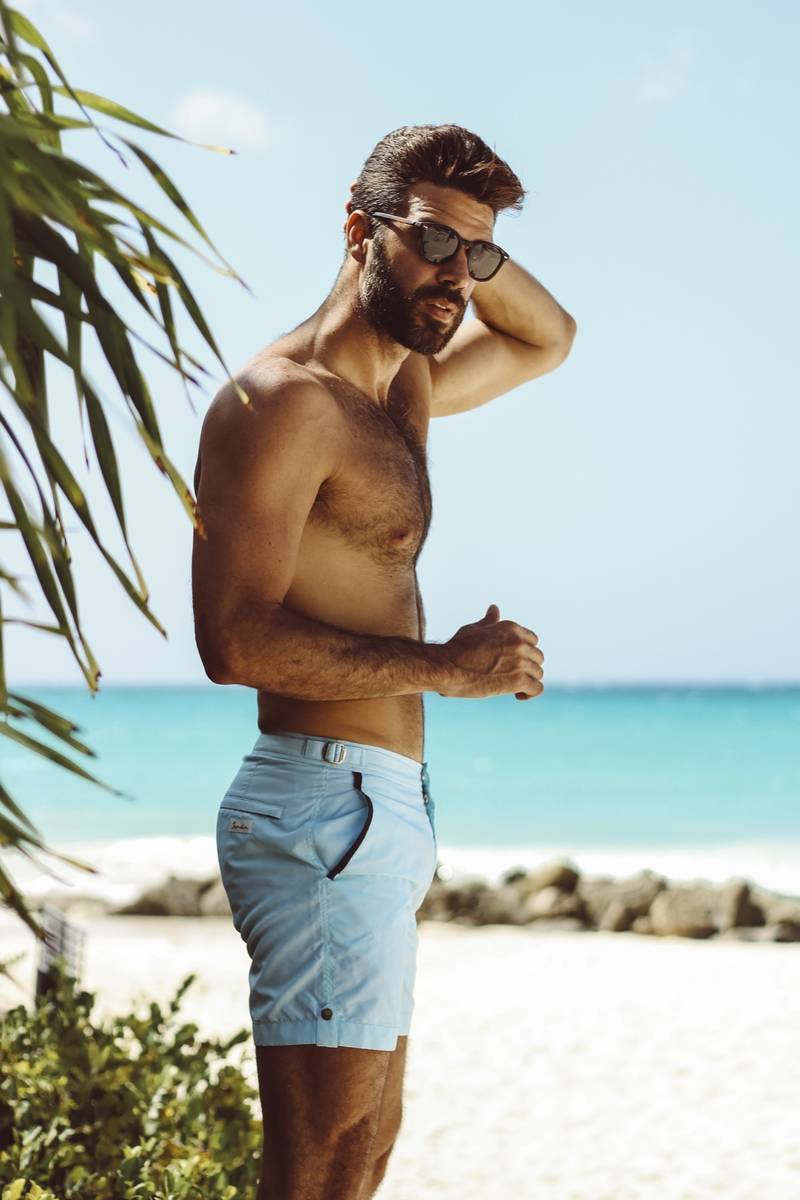
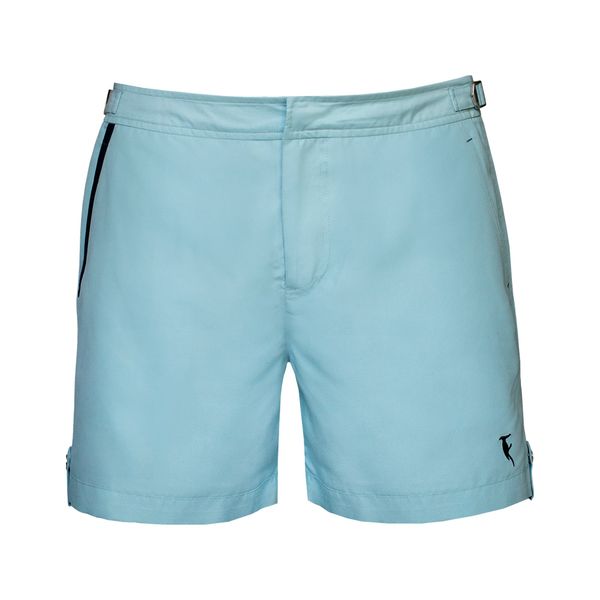 Tampa Solid Sky Bluelight blue, buckles
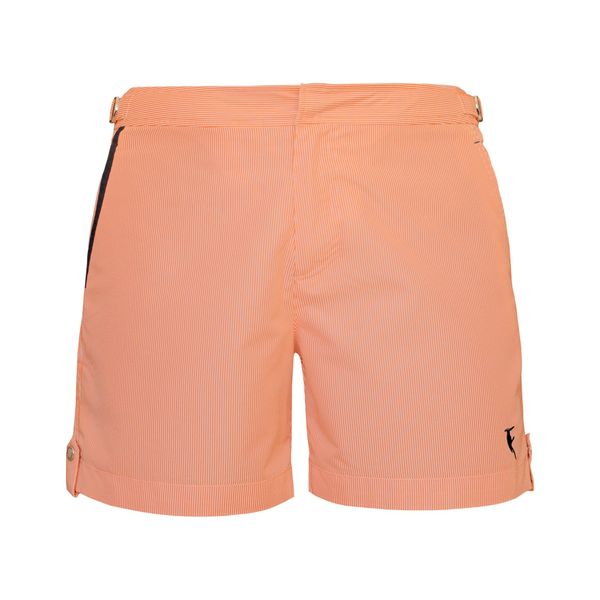 Tampa Stripes Tangerine Orangeorange stripe, buckles
More models and colors for Aruba are in all our swim shorts.
What is the best month for Eagle Beach?
For dry weather, March through June: it rains on 1.5 to 2.8 days a month, least in April. Even in those dry months the wind is strong, 18 to 20 mph (28 to 32 km/h, Beaufort force 4 to 5). It blows hardest in June, on average 20 mph (32 km/h), and weakest in November, 13 mph (20 km/h). Most showers fall from October through January, on 7 to 11 days a month. December has the most rainy days (11.0), November the most rain in millimeters (87.1 mm, about 3.4 inches).
| Month | Wind, mph | Wind, km/h | Rainy days (1 mm or more) | Rain, mm | Turtle season |
|---|---|---|---|---|---|
| January | 16 | 26 | 10.8 | 44.0 | no |
| February | 17 | 28 | 4.5 | 19.5 | no |
| March | 18 | 28 | 2.0 | 10.0 | yes |
| April | 18 | 29 | 1.5 | 8.6 | yes |
| May | 19 | 30 | 1.7 | 14.1 | yes |
| June | 20 | 32 | 2.8 | 17.4 | yes |
| July | 18 | 30 | 4.1 | 31.4 | yes |
| August | 18 | 28 | 3.1 | 19.6 | yes |
| September | 15 | 24 | 3.3 | 42.9 | yes |
| October | 13 | 22 | 7.3 | 76.5 | yes |
| November | 13 | 20 | 9.6 | 87.1 | yes |
| December | 15 | 24 | 11.0 | 80.1 | yes |
From February through August the navy wind columns stand tall and the mint rain columns below them are short; from October through January it is the other way around. The gray bar at the bottom is the turtle season: in the driest months the nesting season on Eagle Beach has already begun. In the winter months the daytime high averages 86 to 88 °F (30 to 31 °C) and the wind keeps it comfortable. In December it rains on 11 days, about 52 hours in all: less than 5 hours per rainy day. How warm the sea is in December, next to six other places, is in sea temperature in December.
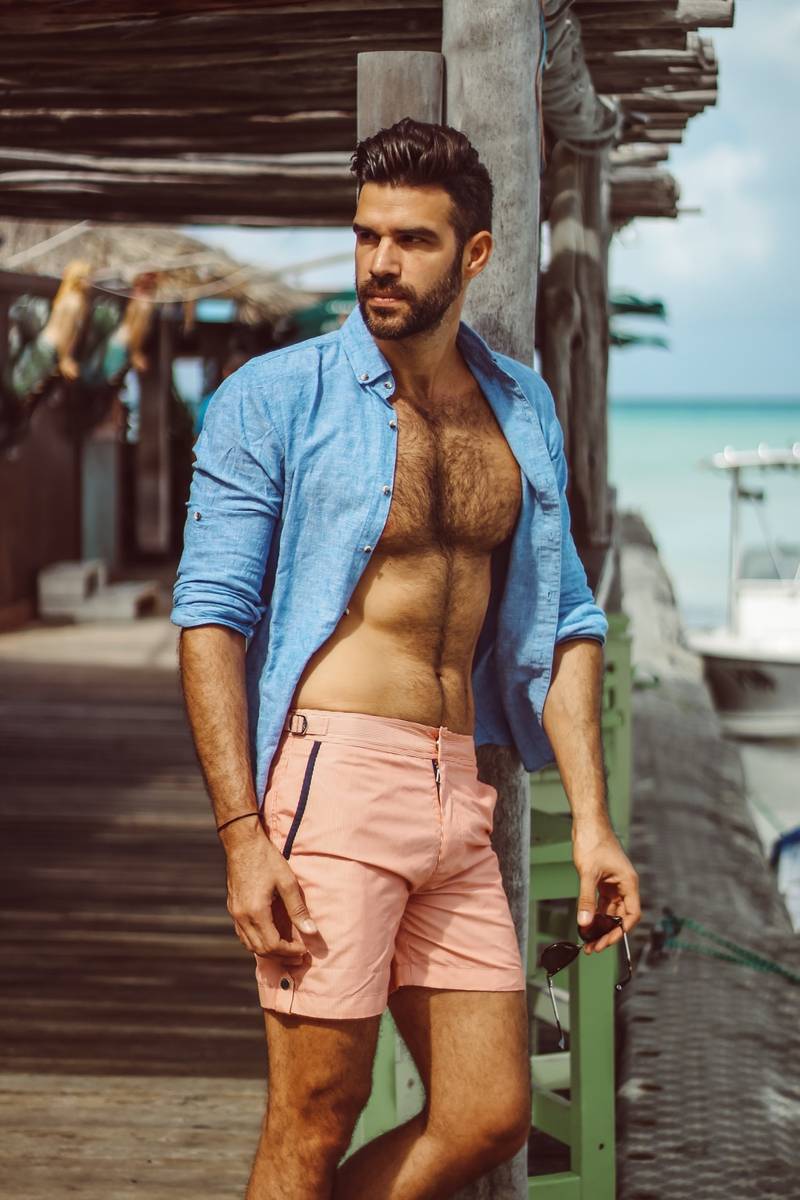
The own shoot of Sanwin Beachwear on Aruba fell in the transition to those dry months, late February and early March 2018.
Access, palapas and snorkeling at Eagle Beach
Is Eagle Beach free to enter?
Yes. Every beach on Aruba is public, Eagle Beach included, and there is a public parking lot. Hotels may rent out loungers, but the sand and the sea belong to everyone.
Can you reserve a palapa on Eagle Beach?
Not a public one. Those are first come, first served, and a hotel may not hold such a palapa for its guests, the Aruba police said in February 2026 to Aruba News. Hotels may rent out chairs.
What is the difference between Eagle Beach and Palm Beach?
Eagle Beach is Aruba's widest beach, with low-rise hotels across the boulevard and two well-known fofoti trees. Palm Beach lies 2.5 km (1.6 miles) further north, is more than 3 km (about 2 miles) long and has high-rise hotels right on the beach, piers and beach bars. Bus 10A stops at both.
Can you snorkel at Eagle Beach?
Eagle Beach is mostly a beach for swimming. For snorkeling the Aruba Tourism Authority names Boca Catalina, Arashi Beach and Mangel Halto, where the reef lies close to the shore.
Can I have swim shorts shipped to Aruba?
Better not: import costs are charged on delivery there. Order them at home before you leave.
How fast do the shorts reach me in the United States or Canada?
Order before 2 pm on a working day and your order ships the same day from the Netherlands. Delivery to the United States and Canada takes 6 to 14 working days. Shipping costs, and the order value from which shipping is free, are shown at checkout. Within Europe delivery takes 3 to 7 working days and shipping is free from two pieces.
Which size Tampa do I need?
Your waist in inches, the way jeans are sized in the United States. The sizes run from 30 to 38, labeled XS to XL, and a size 32 is about 81 centimeters around the waist. The Tampa runs small, so take the larger size if in doubt: the buckles let you tighten the band.
Also read
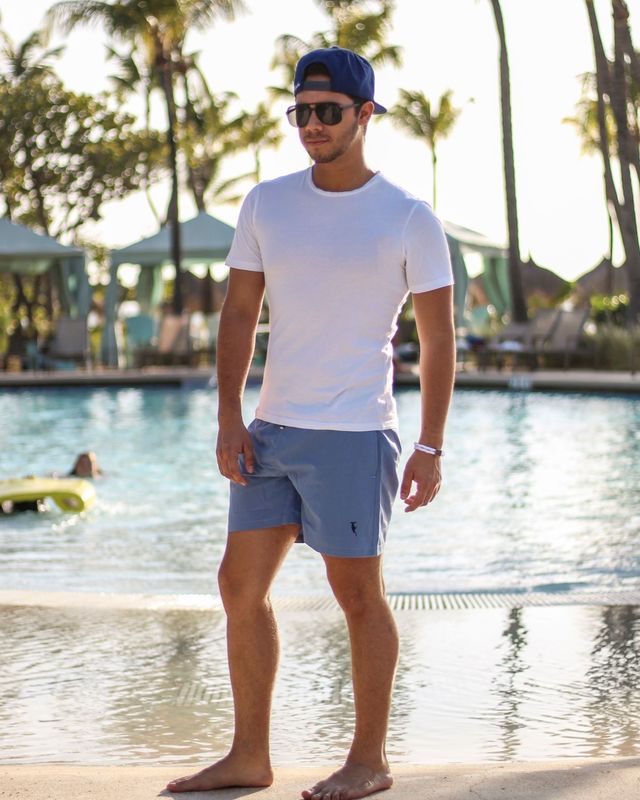
Christmas gifts for him: seven that go on the trip
For anyone shopping in December for a man who travels: seven gifts he wears on the road next year, from his head to his hips, with why each one works on a trip and which swim short size to choose.
Beach vacation packing list for men: one week in carry-on
A week at the beach in the free bag under the seat: the list to tick off, the kilos and litres of British Airways, easyJet, Ryanair and Jet2, and two swim shorts that go with every shirt.
Tipping in France: what the French actually leave
Service is always in the menu price by law. What the French add on top, from the coffee on the terrace to lunch at a plage privée, moment by moment.